
El Paso County Court Records After Arrest
The official path for court records after a jail arrest in El Paso County runs through the Public Case Search Criminal Case module. A jail booking record starts as a custody record. A court record appears when a criminal case is filed, indexed, or otherwise entered into the court system. The arrest charge shown at booking may not match the formal court charge because prosecutors can reject, amend, reduce, enhance, or file different charges after review.
Booking and court records answer different questions. For custody, booking number, and same-day jail lookup, use the county jail inmate records path. For booking photos and what the research could confirm about public images, use the jail roster mugshots page. For court records after a jail arrest, focus on the criminal case, charging instrument, charge status, warrant history, bond record, and final disposition.
The El Paso County Criminal Case Search is the public module used to find court records after an arrest once a case is filed or indexed.
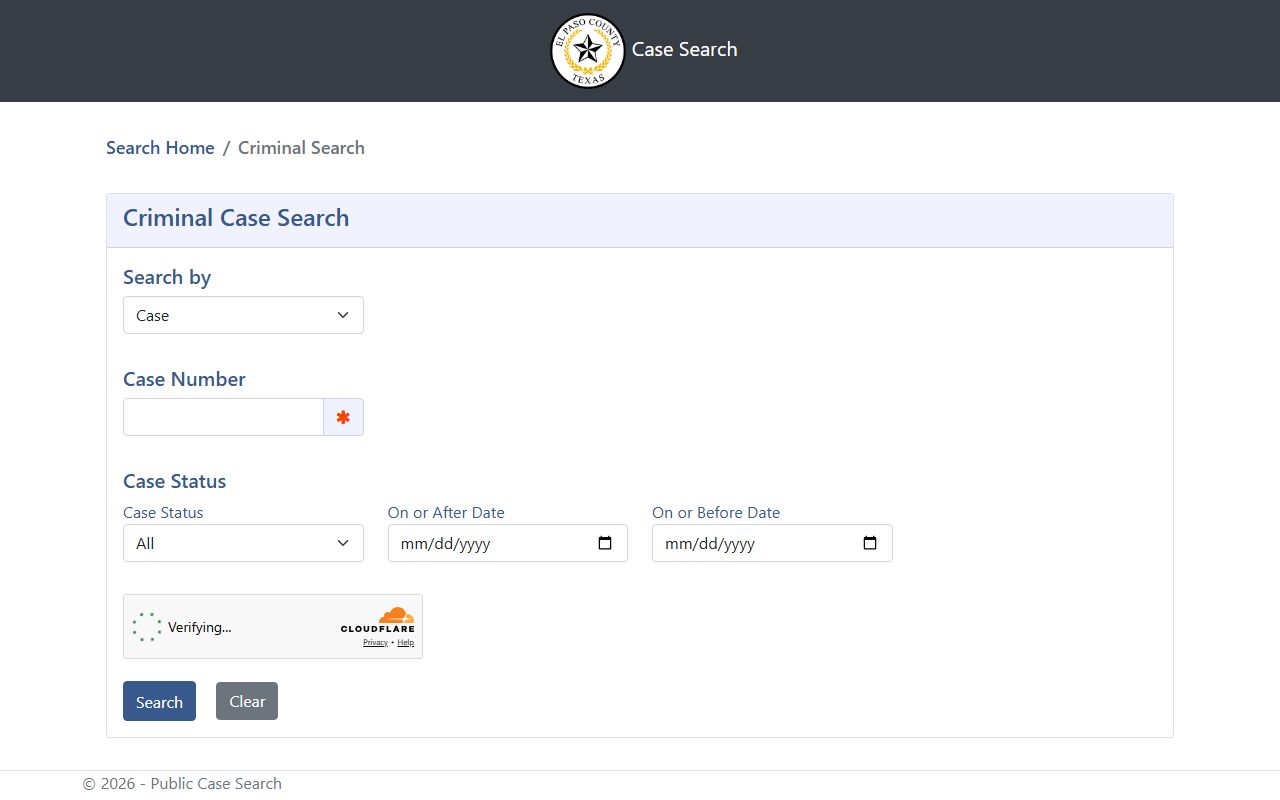
The criminal case form is separate from the jail records form, which is why a new booking can exist before the court case is easy to find.
Find El Paso County Court Records After Arrest
Search timing matters. If the person was arrested today, the jail record may appear before the court case. If the case number is already known from bond paperwork, a citation, a court notice, or jail paperwork, Case mode is the cleanest search. Defendant mode is useful when the name is known but the case number is not. Case Status can be set to All when Open or Closed would hide a relevant file.
- Search the county Jail Records module first if the person was just booked and custody is the main question.
- Open the Criminal Case module after there has been time for filing and indexing.
- Use Case mode when a case number is known from paperwork.
- Use Defendant mode for name-based court records after an arrest. Add date of birth when needed.
- Set Case Status to All when the current status is uncertain.
- Compare booking charges to the filed court charges because they can differ.
Older cases, sealed matters, juvenile matters, expunction issues, and certified copies may require direct court or clerk contact rather than relying only on the online case search.
El Paso County Court Records Search Fields
The criminal case search has more search modes than the jail roster because it serves court records, not just booking records. It allows searches by case, defendant, business, citation, attorney, or bar number. Like the jail search, execution requires Cloudflare Turnstile verification.
| Field Label | Type | Required | Options / Notes |
|---|---|---|---|
| Search by | Dropdown | Yes | Case, Defendant, Business, Citation, Attorney, or Bar Number |
| Case Number | Text | Required in Case mode | Best when known from paperwork |
| Defendant Last Name | Text | Required in Defendant mode | Name-based court case search |
| Defendant First Name | Text | Required in Defendant mode | Name-based court case search |
| Use Soundex | Checkbox | No | Available for name variations |
| Date Of Birth | Date | No | Helps narrow common names |
| Case Status | Dropdown | Yes | All, Open, or Closed |
| On or After / Before Date | Date filters | No | Filing or date range filtering |
| Cloudflare Turnstile | Verification | Yes to submit | Required before search execution |
Arrest to El Paso County Court Records
The local sequence is arrest, booking, magistration, bond review, prosecutor screening, charging document, case entry, hearings, and disposition. District Attorney James Montoya's office is the main felony prosecutor for El Paso County through the 34th Judicial District. County attorney functions can include juvenile matters, hot checks, bond forfeiture, and other county legal work. Prosecutors decide what to file. Clerks maintain the court record once the case exists.
Texas Code of Criminal Procedure Chapter 16 is relevant to the early custody stage before an information or indictment. Chapter 17 governs bail and bond. The court record after an arrest may show one charge at filing, then a different charge later if it is amended, reduced, enhanced, dismissed, or replaced by another charging instrument.
Arrest → booking → magistration → prosecutor review → complaint, information, or indictment → court case → disposition.
El Paso County Arrest Charging Documents
Charging documents turn an arrest event into a court case record. The exact document depends on the charge, court, and prosecutor action. The public case search may show case and charge information after filing, but a full certified copy or older file may require clerk contact.
| Document | Plain Meaning | Common Use |
|---|---|---|
| Complaint | Early charging or probable-cause document. | Magistrate proceedings and early case stages. |
| Information | Prosecutor-filed charging instrument. | Many non-indictment cases. |
| Indictment | Grand-jury charging instrument. | Common for felony prosecution unless waived or otherwise handled by law. |
El Paso County Charge Status Records
Charge status is one of the main reasons to search court records after a jail arrest. A booking charge may be only the starting allegation. The court case can show whether the filed charge remains pending, was amended, was reduced, was dismissed, or ended in a plea, trial verdict, deferred result, or other disposition.
| Status | What It Means |
|---|---|
| Pending / Open | The case or charge remains active in court. |
| Amended | The filed charge changed after prosecutor or court action. |
| Reduced | The charge level or offense changed to a lower charge. |
| Dismissed | The charge was dropped by court or prosecutor action. |
| Closed | The case has reached a disposition or administrative closure shown in the system. |
Bond Records After El Paso County Arrest
Bond records after an arrest are searched through the separate Jail Bond Record Search. That module searches by defendant or bond company, includes Open and Closed bond status, and has posted-date filters. The criminal case search may show the case status, while the bond module is more focused on bond-company and bond-status records.
| Bond Type | How It Works |
|---|---|
| Cash bond | Money posted directly where the proper authority accepts it. |
| Surety bond | A licensed bail bond company posts the bond. |
| Personal bond / PR bond | Release based on promise and court-set conditions. |
| No-bond hold | A court order, warrant, parole hold, ICE hold, or federal issue may prevent release. |
Warrant Records After El Paso County Arrest
The county Warrant Search is name-based and requires first and last name, with middle name and date of birth as optional fields. It also requires Turnstile to submit. A warrant can lead to arrest and booking, but a failed public search does not prove no warrant exists because spelling, timing, recalls, sealed matters, and municipal-court systems can affect search results.
Check the criminal case search to see whether a warrant is connected to an open or closed case. Check jail records to see whether the warrant already led to a booking. Call the responsible court or law-enforcement agency before walking in to resolve a warrant.
El Paso County Charges vs Convictions
An arrest and a charge are not the same as a conviction. An arrest means a person was taken into custody. A charge is a formal accusation in the court record. A conviction requires a plea, verdict, or other legal finding. Court records after an arrest should be read with that sequence in mind.
| Point | Charge | Conviction |
|---|---|---|
| Stage | Accusation after arrest or filing | Final finding by plea, verdict, or judgment |
| Can change? | Yes, charges can be amended, reduced, or dismissed | Changes usually require later court action |
| Use in screening | Needs context and lawful purpose | Still must be used under applicable law |
Sealed and Expunged Arrest Records
Texas expunction rules are in Code of Criminal Procedure Chapter 55A. Expunction is the statutory route for qualifying arrest-record clearing. The research did not locate a local shortcut that removes a jail or court record just because a person asks. Eligibility depends on the case result and Texas law.
| Issue | Sealed / Restricted | Expunged |
|---|---|---|
| Public view | Hidden or limited from ordinary public access where ordered | Treated as removed from public access where granted |
| Record source | Court order and agency compliance matter | Court order and statutory eligibility matter |
| Best path | Check the court record and applicable Texas law | Use Chapter 55A and court process |
Note: Juvenile matters, sealed records, active investigations, protected identifiers, and security-sensitive jail information may be restricted even when other case data is public.
El Paso County Prosecutor Records
The El Paso County District Attorney, James Montoya, is the main felony prosecutor for local adult criminal cases. The District Attorney decides whether to accept, reject, amend, enhance, reduce, or file charges after arrest. That is why the jail booking charge should not be treated as the final filed court charge. Prosecutor decisions shape the court record, but the jail booking record still starts with Sheriff's Office custody and booking systems.
Public-information routing should follow the record type. Jail booking records start with the Sheriff's Office and county jail records process. Court records are searched through the county case-search system or court clerk channels. Prosecutor files may be subject to different rules and exceptions.
El Paso County Arrest Records Limits
Court records after a jail arrest can be useful for personal review, case tracking, and locating the formal filed charge. They are not a substitute for a lawful consumer background check. Public search results can be incomplete, delayed, sealed, redacted, or changed after court action.
Important: Do not use public court or jail lookup results for employment, credit, housing, insurance, or another FCRA-regulated decision.